Stay Off That Foot!! (And Stay Fit While It Heals)

Injury often strikes suddenly and wipes out your sports plans.  It happens all the time to runners who increase speed while training for races.  It happens to basketball players as the season starts to heat up.  And it can happen to you when you’re feeling in great shape for tennis, soccer, baseball, volleyball or any other recreational activity.  Maybe you sprained your ankle, strained an Achilles, broke a toe, or developed plantarfasciitis.  Or maybe you had pre-planned trauma to your foot, such as bunion surgery.

The worst part of such an injury or surgery is not being able to participate in the activity that means so much to you.  But very quickly, you realize that it’s equally distressing to begin losing fitness because you aren’t running, reaching, hitting, stretching, and sweating for the hours each week that is normal for your body.  Without the high-level exercise your muscles and cardiovascular system are used to, you can lose strength quickly, so you must respond quickly.

With a foot injury, you’re especially challenged, because you have to keep some or all of your weight off of it while it heals.  So what are you going to do?  You can do what the pros do.

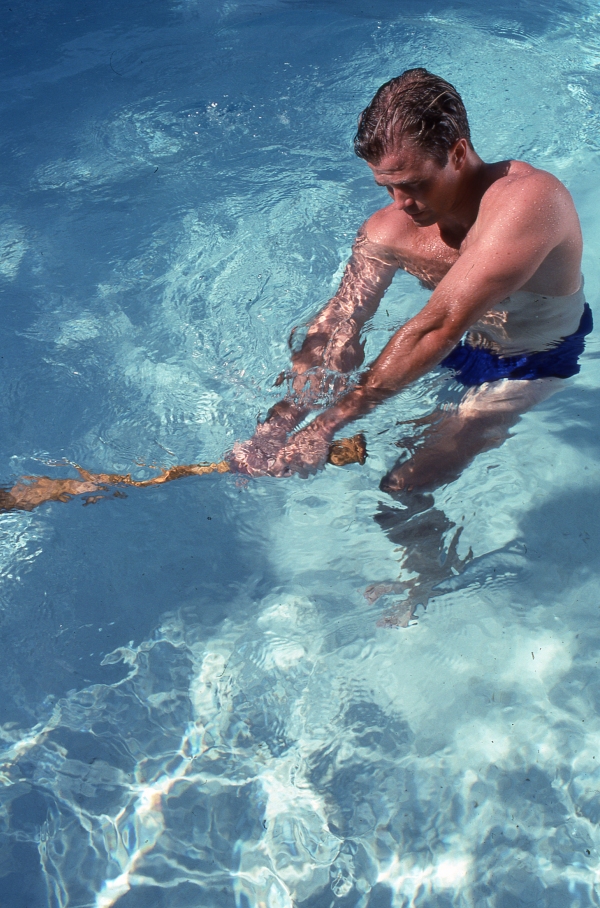
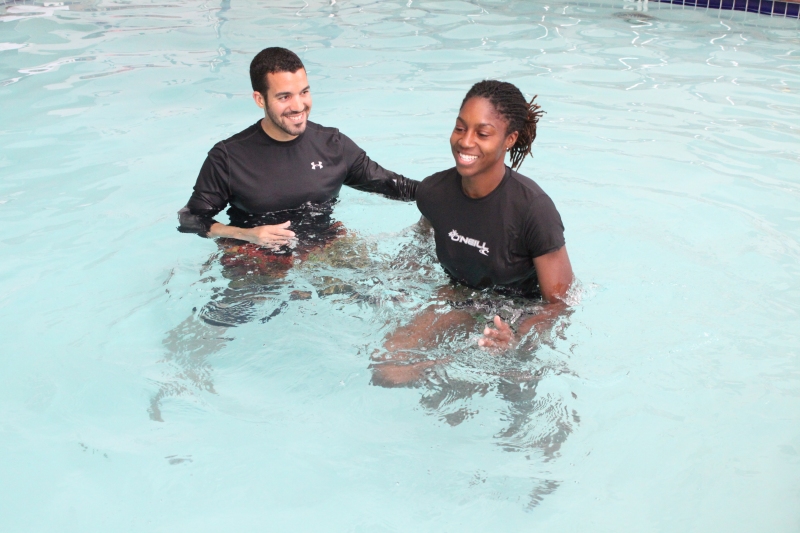
Find a pool that has water deep enough that your feet won’t touch the bottom.  Next, strap on a flotation belt that will hold you upright for some deep-water exercise.  Even if you’re a good swimmer, you’ll want to wear a belt so that you can concentrate on good form, not make extraneous stay-afloat movements.

Stay in shape with this program

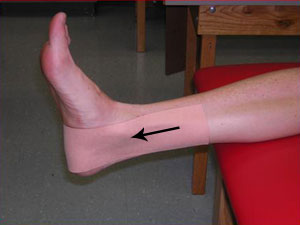
If any of these movements increase the pain in your ankle, Achilles, or foot, find an athletic trainer or physical therapist who can tape your foot to immobilize it during the exercises.

1. Deep Water Running

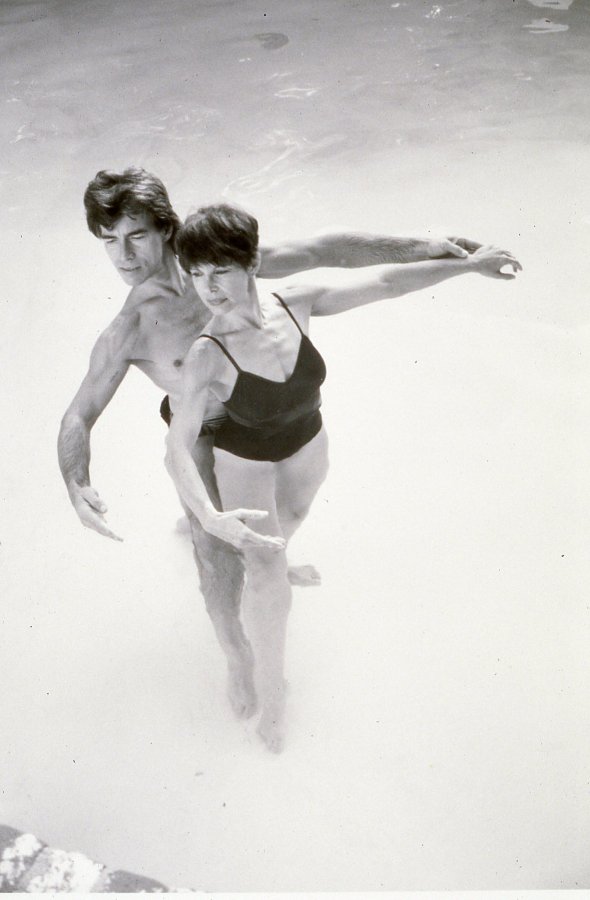
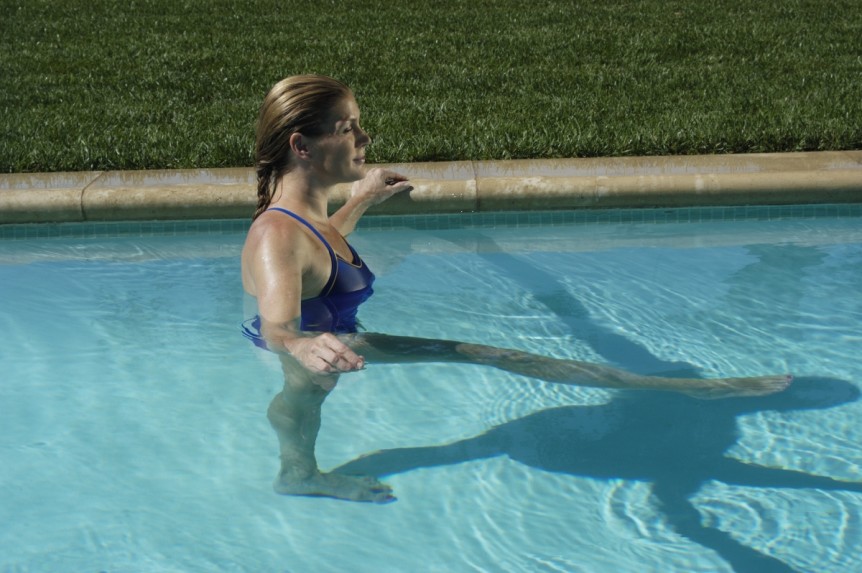
Begin running in an upright position as shown below.  Use the exact motion of good running form on land.  Your head and chest are erect; shoulder are relaxed and down.  Eyes focus straight forward to keep the head level and unmoving.  Pull one elbow back and then the other as you lift the opposite knee.

Waterpower Workout Deep Run

2. Water Walking

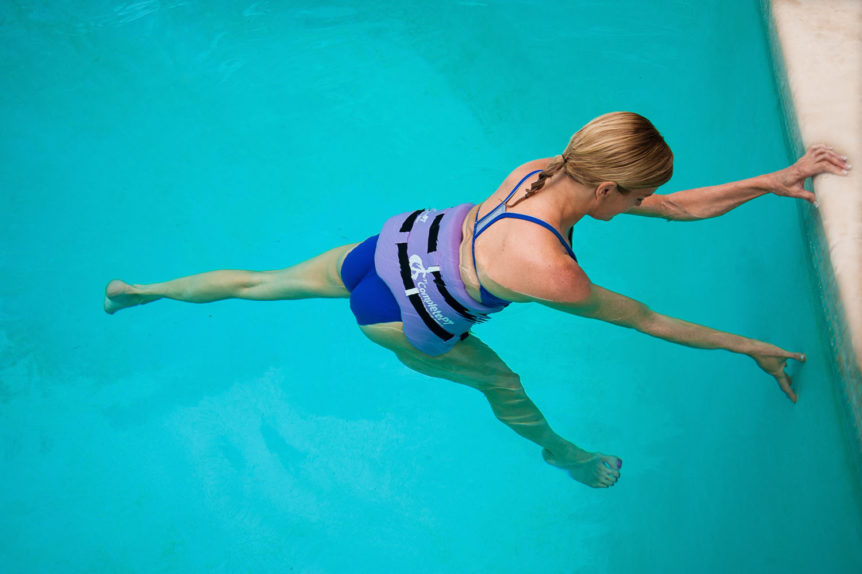
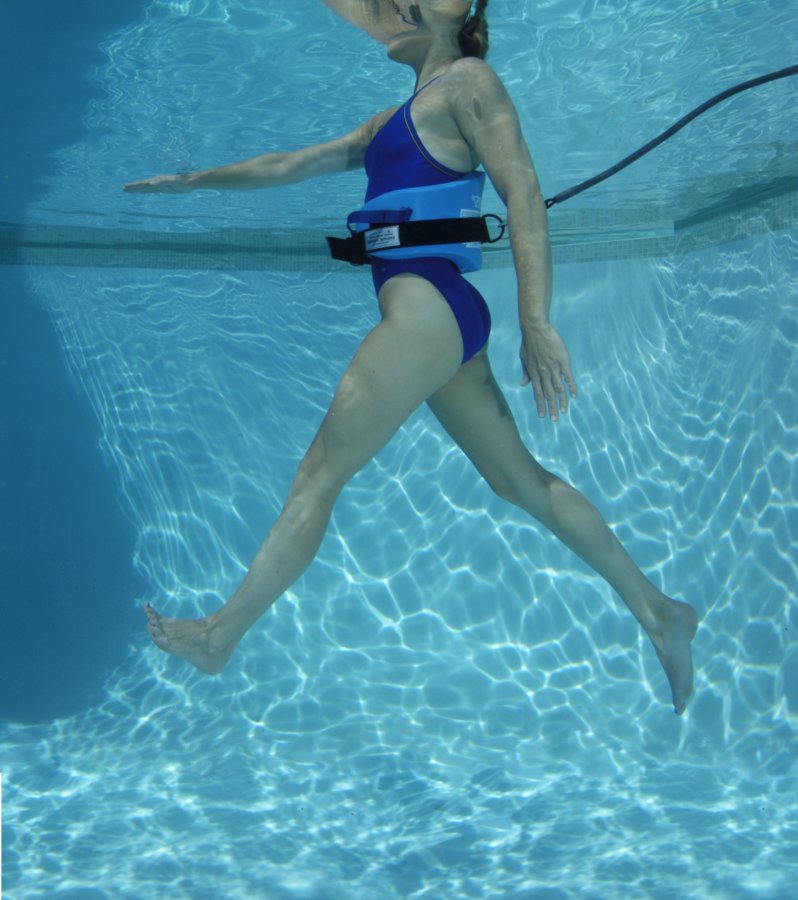
Establish an “opposition position” by reaching your right arm and left leg forward at the same time as shown below.  Keep both arms and both legs completely straight as you begin swinging them forward and backward.

Waterpower Workout Power Walk

3. Flies

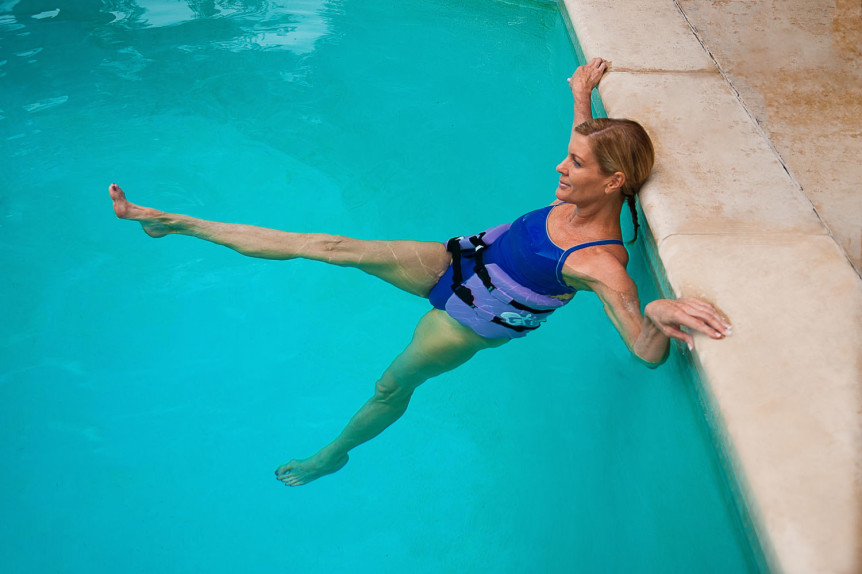
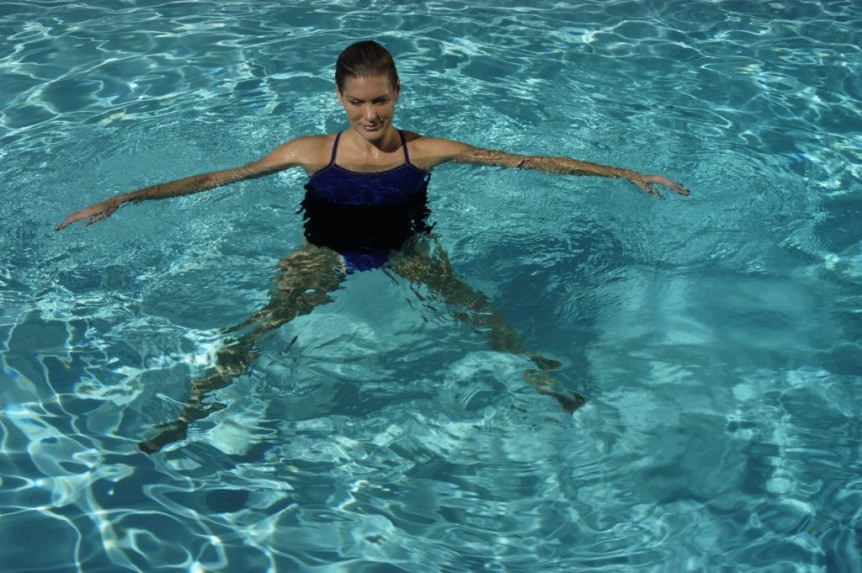
Start with your arms and leg together as shown below (left).  Open your arms and legs wide as shown below (right).  Keep your hands flat, slicing sideways just below the surface of the water.

Waterpower Workout Waterpower Workout Flies

4. Interval Training

Now mix up these three exercises going faster and slower on the running and walking to get your heart rate up.  Use the Flies for a recovery period between higher-intensity periods.  See The Complete Waterpower Workout Book for many examples of a good interval training program.

After the aerobic and anaerobic training of deep-water intervals, you can stretch and do other exercises as shown in Lynda Huey’s Waterpower Workout DVD.

Finish up with specific rehab exercises for your ankle and foot

5. Toes Up, Toes Down

Gently lift your toes up, then push them down to regain strength and range of motion in your ankle and foot.  As you heal, you can increase reps and speed.

6. Foot Circles

Circle your foot clockwise, then counterclockwise.  As you heal increase reps and speed as well as the size of the circle.

7. Walk on Toes; Walk on Heels

Walk across the pool in chest-deep water.  Make sure you’re walking without a limp before trying next to walk on your toes.  Then try walking on your heels.  If either causes you pain, wait and try again next week.

Lynda Huey, M.S., founder of CompletePT and Huey’s Athletic Network, is a former athlete and coach whose own injuries led her into the water to find fitness and healing. She was educated at San Jose State University where she starred on the track and field team during its golden years.  Lynda is the author of four books on water exercise and water rehabilitation.

Print Friendly
Posted in Home Exercise Programs, Physical Therapy, Preventing Surgery, Waterpower Workout | Tagged , , , , , | Leave a comment

Water Warm-Down Recovery

After a major athletic effort, your body can feel out of balance.  It might feel as though you need food, drink, a hot bath, a nap, or a massage.  All of those can definitely help.  But here’s another thing you may not have considered:  a water workout to speed your recovery.

The demands placed on the body during exercise leave the muscles and the circulatory system in an altered state when the exercise is completed.  Although the pumping action of the heart is responsible for blood reaching the muscles, there is no parallel system to return the blood to the heart and lungs for revitalization.  Instead, the body relies largely on skeletal muscle contraction to squeeze the blood through the veins back toward the heart.  As the muscles of the limbs contract, they exert pressure on the veins in the immediate area, and blood is pushed along its path.  Valves housed in the veins allow the blood to flow in one direction only – toward the heart.

When exercise stops abruptly, the muscles are left with large volumes of waste-laden blood without a means for getting home.  When exercise is performed in an upright position, there is pooling of blood in the legs.  The faster this blood is returned to the heart, as when one performs a warm-down, the faster the body can return to its normal state of functioning.

After exercise, muscles are left in a shortened and swollen state.  By means of stretching and lengthening exercises, the muscles are returned to their normal resting length and are better prepared for total recovery.  When these exercises are performed in water, there are several extra benefits:  1)  The hydrostatic pressure of the water flushes waste products out of the muscle tissues and into the bloodstream, and 2)  the massage effect on the body of movement through water assists the return of blood to the heart.

The Water Warm-Down that follows has been used by elite and recreational athletes of many sports and has become invaluable as an integral part of their training programs.  You can do this twenty-minute water warm-down:

  • Immediately after a land-based workout or competition in which you have overexerted.  You will be less sore tomorrow.
  • After a sprint workout.  “Untie” those knots in your hamstrings and gluteal muscles.
  • After a long plane flight.  A water warm-down helps alleviate jet lag.
  • If you are physically or mentally tired and don’t feel up to your usual day’s training schedule.  You will feel rejuvenated when you get out of the water.

If your muscles are sore but not your joints, choose the Shallow program.  If your joints feel overworked, do the Deep program.  Move slowly.  Emphasize range of motion, not power or strength.  Stretch and loosen the body.  Don’t create more workload.

SHALLOW

Enter the pool and move to chest-deep water.  Sit low in the water so that your leg muscles don’t have to do much work.  Slowly do each exercise 10-15 times, depending on how you feel.  Stretch and lengthen your muscles as you move.

  1. Lunges.  Start in the position shown below.  Bounce and change which arm and leg are forward.
    Lunges
  2.  

  3. V-Kicks.  Start in the position shown below.  Bounce onto your right leg, lift your left leg and swing both arms to the left.
    V Kicks
  4.  

  5. Front Kicks.  Start in the position shown below.  Notice how low she is in the water.  Bounce onto your right leg and lift your left.  Move the arms in opposition as shown.
    Front Kicks
  6.  

  7. Frog Jumps.  Sit low in the water standing on both feet.  Without jumping, lift both knees toward your chest as shown below.  After you finish your reps in this position, do another set with your knees wide to the sides as shown below.
    Frog Jumps
  8.  

  9. Kicking.  Sit on a step or ledge of the pool and brace yourself as shown below.  Perform a gentle flutter kick for about a minute then begin bicycling for another minute.
    Kicking
  10.  

DEEP

Put on a flotation belt that will keep your chin above the water level.  Move to the deep end of the pool.  Spend at least three minutes doing each of these exercises.

  1. Water Running.  Use good form while you slowly run without impact as shown below.
    Deep Run
  2.  

  3. Water Walking.  Keep your legs relatively straight and stretch one forward and one backward gently as shown below.
    Power Walk
  4.  

  5. Flies.  Open your arms and legs then bring them back together.
    Flies
  6.  

  7. Kicking.  Sit on a step or ledge of the pool and brace yourself as in photo 9.  Perform a gentle flutter kick for about a minute, then begin bicycling for another minute.
    Back Flutter
  8.  

Ideally, you should move to the pool and your Water Warm-Down Recovery right after your tough workout, game, or race.  But even if hours go by, or the entire day, your body will still thank you if you can slide into water’s magical freshness sometime before the day is over.

Lynda Huey, M.S., founder of CompletePT and Huey’s Athletic Network, is a former athlete and coach whose own injuries led her into the water to find fitness and healing. She was educated at San Jose State University where she starred on the track and field team during its golden years.  Lynda is the author of The Complete Waterpower Workout Book.

Print Friendly
Posted in Home Exercise Programs, Physical Therapy, Pre-Surgical Rehab, Preventing Surgery, Waterpower Workout | Tagged , , , | Leave a comment

October is National Physical Therapy Month

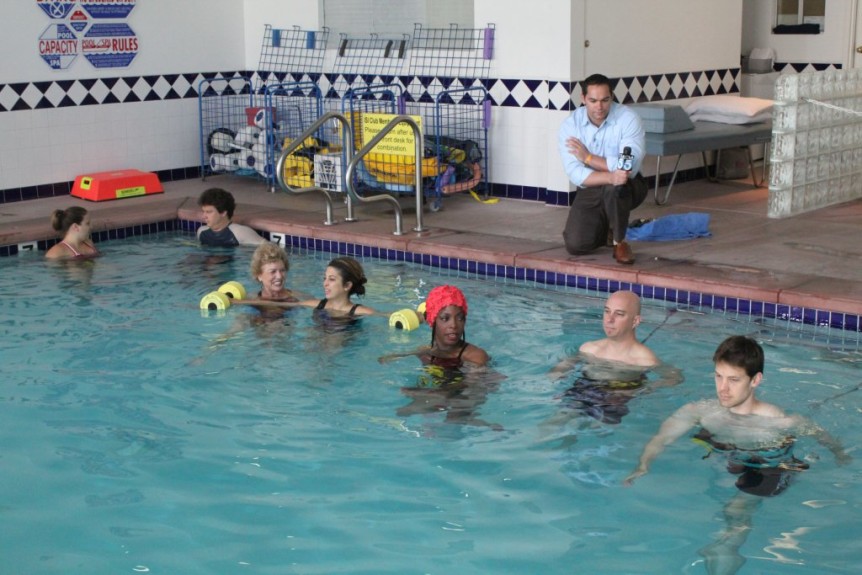
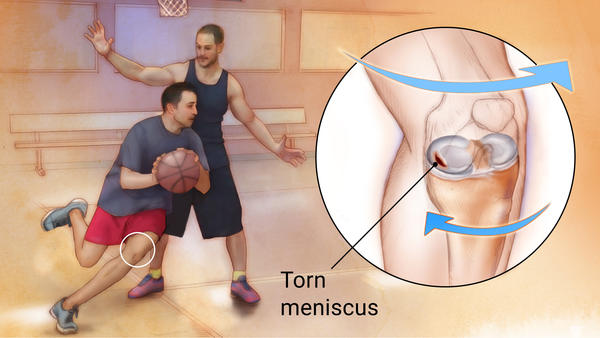
KTLA reporter, Gayle Anderson, had a torn meniscus in her right knee.  She had just gotten approval from her insurance company for a knee surgery when she came to CompletePT’s pool for the first time.  She wasn’t there as a patient, but doing a news story on pool therapy.  Orthopedic surgeon, Robert Klapper, M.D., was part of that segment along with me, my staff and our patients.  Dr. Klapper advised Gayle not to have the meniscus surgery, but instead to get into the pool for two to three months to help the knee repair itself without surgery.  Gayle was skeptical, but she sensed something true in the bold New Yorker’s tone and she went for it.

Gayle stayed in the pool with us for many months, not stopping just because the pain went away, but using the water rehab program for high-end athletic training and fitness.  She had been a former basketball player and knew what it felt like to be in top shape – and she wanted that back again.  By the time she left CompletePT, she was sprinting at top speed in elbow-deep water and doing high-intensity plyometric jumping exercises in chest-deep water.  She never had knee surgery.

Gayle was back at CompletePT today, featuring us because October is National Physical Therapy Month.  While we had done pool stories with her previously, we had never focused on the excellent land therapy we also provide.  This time Gayle wanted to show both.

National Physical Therapy Month - Land Therapy National Physical Therapy Month - Land Therapy

Assistant Clinical Director, Kevin Wagner, MSPT, CSCS, had three of his top male patients available for the land shoot.  A stuntman had sustained a left hip injury that affected the surrounding muscles.  Kevin had him doing strengthening exercises for the camera.  A Disneyland barber shop quartet singer was rear-ended by a texting teenager going 65-miles per hour causing serious strain to his neck and upper back.  He couldn’t turn his neck.  Now, thanks for Kevin’s manual work on the neck and upper back muscles, his neck is becoming mobile.  The third patient was 17 when he broke his neck playing high school football.  He has a partial spinal cord injury.  He started in the pool for many months before transitioning to land where he could gain strength against his worst enemy, gravity.  This patient told me today that he feels completely human while he’s in the pool because he can do just about anything he wants to:  he can do squats, marching, side stepping and much more.  Then he gets out and gravity prevents him from doing a lot of basic movements of daily living.

National Physical Therapy Month - Aquatic Therapy National Physical Therapy Month - Aquatic Therapy

After shooting two 2 to 3-minute segments, we moved to the pool for two more segments.  The stuntman and the football player joined a full group of therapists and patients already there.  A young woman with four young children told how she came to CompletePT in a wheelchair four years ago and now she can walk.  She has Stage 4 breast cancer that has metastasized to her liver and bone and now into her brain.  She said physical therapy saved her life by keeping her strong and motivated so she can be here for her children.  A stage manager who moved a 400 lb. desk and ruptured a lumbar disk explained how he could now sleep at night because he’s out of pain, how he can walk, and bike, and do normal daily activities without being in constant pain anymore.

Gayle always makes any TV shoot high spirited and lots of fun.   Today, however, what caught my attention the most was the complexity of the patients being seen and how well they are responding to both our pool and land physical therapy.

Watch the TV segments here.

Lynda Huey, M.S., founder of CompletePT and Huey’s Athletic Network, is a former athlete and coach whose own injuries led her into the water to find fitness and healing. She was educated at San Jose State University where she starred on the track and field team during its golden years.

Print Friendly
Posted in Physical Therapy, Post-Surgical Rehab, Pre-Surgical Rehab, Preventing Surgery, Uncategorized | Tagged , , , | Leave a comment

Stop Hurting Your Knees!

Many people with sore knees have never exercised.  Others haven’t exercised in years or have exercised far too little.  But a large number have damaged their weightbearing joints, especially their knees, by playing abusive sports with a passion.  There is a growing epidemic of knee problems, especially in aging baby boomers who are devoted to running, skiing, basketball, volleyball, or racquetball, and who, because they aren’t built for these sports or haven’t had coaching to learn proper body mechanics, have created knee problems with every workout, race, or game.

Yet they continue to pursue abusive activities with excessive regularity.  Running too many miles, playing too much tennis, lifting too many pounds, or skiing too many moguls when your knees are warning you to stop is a sure way to create an increasingly serious knee problem.

Your knees are your responsibility and you must assume all risk for them. By selecting your physical activities more wisely, you can have an injury-free sports or fitness program.

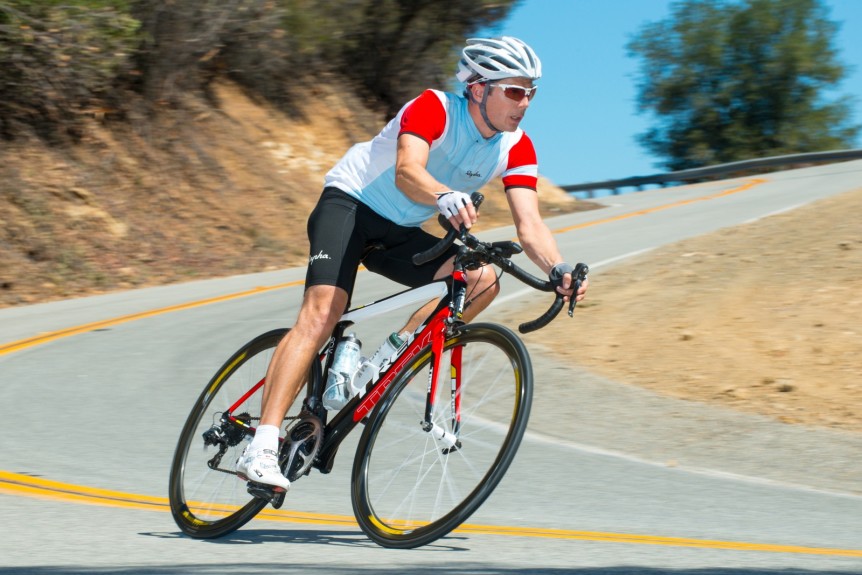
Exercise comes in two flavors:  nurturing and abusive.  The sports people love most abuse the body’s weightbearing joints, whereas pool exercise, bicycling, ski machines, and elliptical machines remove most or all impact from the weightbearing joints and are therefore nurturing.  Most people don’t consider the abusiveness of their exercise routine until pain or physical limitation strikes.  At that point, they pay attention.  If you’re ready to change the flavor of your exercise program, try using the safe forms of exercise most of the time to maintain and enhance fitness so that you may be able to continue occasionally your beloved sports and activities for years to come.

POOL PROGRAM

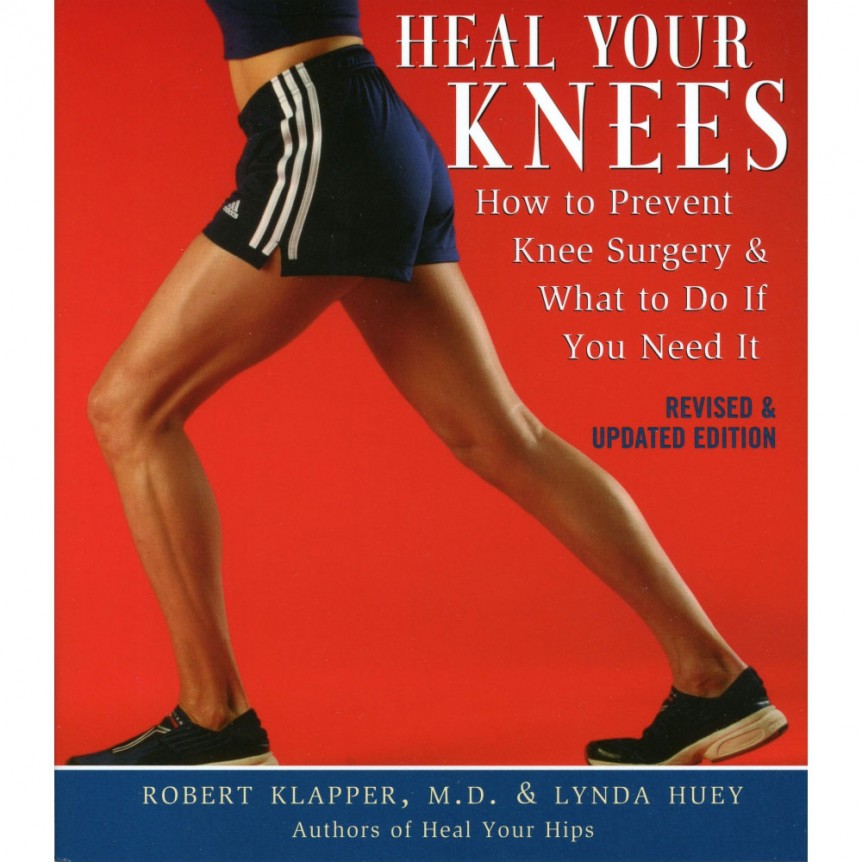
A pool program is the first choice for a nurturing workout because you can eliminate all weightbearing when exercising in deep water.  Put on a flotation belt and run, powerwalk and do deep-water intervals until you get the aerobic and anaerobic intensity of workout you desire.  Then stretch and do the kicking series described in details in the NBA blog post.  You can keep the belt on or take the belt off and do some sprint intervals in place in chest-deep water if you need more.  A full program is shown in the book Heal Your Knees and you can buy a laminated exercise sheet with photos of the exercise to use deckside at your local pool.

BICYCLE PROGRAM

Bicycling nurtures your back, hips, knees, feet, and lower legs because you don’t have the full weight of your body crashing into those joints as you ride.  The cycling motion uses the hinge joint part of the knee’s function only.  It doesn’t place any rotational torque on the knees, which can cause injury to structures inside the knee such as happens in basketball, racquetball and tennis.  Further, biking focuses primarily on the quadriceps muscles at the front of the thigh, the source of key protection for the knees.

Athletes generally prefer the traditional bike on which you sit upright.  Older people and those with back problems often prefer the recumbent bike, which lets you sit closer to the ground with your legs pumping in front of you.  Most gyms have both, so give both bikes a solid try to see how you feel after each.  Suggestions for starting and increasing a bike program are in the book Heal Your Knees.

SKI MACHINES AND ELLIPTICAL MACHINES

Both of these machines offer a low-impact weightbearing exercise that is nurturing because you are not picking up your feet and forcing them down.  They remain in contact with the machine at all times.  Theres’ no jarring of the hips, back, or knees.  And they offer a bonus:  they strengthen your mid-body, because those muscles are constantly working to stabilize you in an upright stance.

Nearly all gyms have elliptical machines and many have ski machines.  Ask a trainer at the gym to help you get start and progress in your program.

TRAINING LIMITS

Depending on your sports background and training knowledge, you may be able to set your own training limits by planning a wise blend of nurturing activities along with an occasional soul-satisfying foray into your favorite but abusive sport.   Most people, however, need guidance identifying and limiting the abusive exercises in their weekly routine.

The Huey-Klapper Activity Point Scale for Knees below lists many popular sports and fitness activities.  It will help you identify the sports you should increase in your healthy-knee lifestyle and the ones you should limit.  Notice that each workout time unit is given a point value.  The most nurturing activities are 0 points; the most abusive ones are 12 points.  The other activities fall somewhere between at 3, 6, or 9 points.

The Huey-Klapper Knee-Point Scale

All point values shown are for one hour of that activity. For longer or shorter periods, modify points accordingly (divide in half for thirty minutes of activity, etc.)
ActivityTimePoints1-Hour Equivalents
Aerobics class1 hour99
Ballet class -- barre work1 hour66
Ballet class -- floor work1 hour99
Baseball1 hour66
Basketball30 minutes1224
Bicycling -- stationary30 minutes00
Bicycling -- road bike, flat30 minutes00
Bicycling -- road bike, some hills30 minutes36
Bicycling -- mountain bike30 minutes612
Body boarding -- no fins1 hour00
Body boarding -- fins1 hour33
Elliptical training machine30 minutes612
Football -- contact1 hour1212
Football -- touch/flag1 hour1212
Golf -- riding in cart1 hour00
Golf -- walking1 hour66
Hiking -- mostly flat30 minutes33
Hiking -- some hills30 minutes66
Hiking -- steep hills30 minutes99
Kickboxing1 hour1212
Martial arts1 hour1212
Pilates -- mat30 minutes00
Pilates -- reformer30 minutes612
Pool workout30 minutes00
Racquetball1 hour1212
Rowing1 hour33
Rugby30 minutes1224
Run -- asphalt, concrete30 minutes918
Run -- grass, dirt, track30 minutes612
Run -- striding on track30 minutes612
Ski machine30 minutes00
Skiing -- cross-country30 minutes36
Skiing -- downhill, bumps30 minutes1224
Skiing -- downhill, groomed, no bumps30 minutes612
Soccer1 hour1212
Softball1 hour612
Stair-climbing machine30 minutes1212
Step aerobics class1 hour1212
Stretching (non-weightbearing)30 minutes00
Surfing (no knee paddling)1 hour33
Surfing (knee paddling)1 hour66
Swimming -- crawl30 minutes00
Swimming -- breast stroke30 minutes918
Tennis -- doubles1 hour66
Tennis -- singles1 hour1212
Therapy exercises for knees30 minutes00
Treadmill walking30 minutes612
Volleyball -- beach30 minutes612
Volleyball -- indoors30 minutes918
Walking -- flat30 minutes36
Walking -- hills30 minutes612
Weight training -- total body30 minutes1212
Weight training -- lower body30 minutes1212
Weight training -- upper body30 minutes00
Yoga -- standing poses1 hour99
Yoga -- lying, sitting poses1 hour33

Start a list to keep track of the points in your weekly workout routine.  Write the day at the top of the page and list everything you did that day whether it was planned exercise or unavoidable exercise such as walking fifteen minutes in a parking garage to find your car.  Look at the Huey-Klapper Scale to assign a point value to your activities.  Add or subtract more points depending on how long you continued.  Keep this list going for one full week, then tally all your points for a grand weekly total.

Your point total may be as high as 130 to 190 points.  If so, that’s a clue to your current problem.  You’ve probably been hurting your knee with too much abusive activity. So how many points are right for you?   Your age, your weight, your knee alignment, your good or bad form while performing your activities, and your history of knee problems or surgeries will tell you how much you should limit your activities.  Think of it this way:  just as people count calories to control their weight, you can now count activity points to see if you’re nurturing or abusing your knees.  The chart below shows you how to determine your weekly recommended point total.  Start with 100 points, then add and subtract points as they apply to your current situation today. The number you arrive at is your critical threshold for the week:  stay under that number to maintain optimal knee fitness.

Huey-Klapper Knee-Point Assessment

Circle numbers in each column that describe your current condition.
Total each column in boxes A & B (be sure to include 100 base points).
Base PointsDeductions
This is your recommended total Knee Points per week.
Start with 100 points100
Under 3030
Under 4020
Age 45-5510
Over 5520
Over 6530
Good form during exercise10
No training on good form10
History of knee problems (but not currently)10
Current knee problems (no surgery)20
Ideal body weight10
Overweight 20 lbs.10
Overweight 30 lbs.20
Overweight 40 lbs. or more30
Slightly knock-kneed or bowlegged10
Badly-aligned knees30
Knee pain after exercise10
Knee instability20
Knee surgery (over 1 year ago, after age 18)30
Knee surgery less than 9 months ago40
Knee surgery less than 6 months ago50
Knee surgery less than 3 months ago60
________________________
Total each column as it applies to you:AB
Total Base Points (from box A)
Total Deductions (from box B)-
Subtract box B from box A=

Keep your goal firmly in mind:  you want to be able to continue the sports you love on an occasional basis, so keep them that – strictly occasional – and do nurturing exercises for your daily fitness maintenance.  This may sound like a huge sacrifice at first, but as soon as you realize you’re saving your knees for years to come, you’ll start savoring your once-a-week run, or basketball game, or tennis match as pleasure enough in exchange for your knees.

Lynda Huey, M.S., founder of CompletePT and Huey’s Athletic Network, is a former athlete and coach whose own injuries led her into the water to find fitness and healing. She was educated at San Jose State University where she starred on the track and field team during its golden years.  Lynda has helped dozens of patients prevent knee surgeries with her pool rehabilitation program.

Print Friendly
Posted in Home Exercise Programs, Physical Therapy, Preventing Surgery, Uncategorized, Waterpower Workout | Tagged , , , , , | Leave a comment

The Things I learned from Pat Connolly

Pat Connolly

"Stick!"

If you have ever had a great coach, you know that you have heard that coach’s voice inside their head during workouts for years afterward.  You’re getting ready to knock off the workout early and you hear, “This is the point where you start to get in shape,” loud and clear from the absent coach.  Or as you’re running along, you hear your coach’s silent voice tell you, “Good arm action.”

Last week, one of the truly great American track and field coaches came through Los Angeles visiting family members.  She and I had competed together on the Millbrae Lions Track Club in the 1960s.  Pat Connolly was a three-time Olympian:  1960 she ran what was then the longest event for women, the 800M; 1964 and 1968 she was our best pentathlete before two more events were added to create today’s current heptathlon.  Obviously, she was the star of our club in the San Francisco Bay Area.  In the 1970s, Pat and I had both settled on the Westside of Los Angeles.  She was the first coach of the Women’s UCLA Track and Field Team where she coached sprinter Evelyn Ashford and her team to national championships in 1975 and 1977.  In 1984, Pat helped Evelyn win two gold medals at the Games in L.A.  In 1985, she invited me to work out with her world-class athletes Marlene Harman (heptathlon) and Diane Williams (sprinter) who were fifteen years my junior.

Olympian and Olympic Coach Pat Connolly

Olympian and Olympic Coach Pat Connolly visited Lynda Huey’s CompletePT clinic at the Jodie Foster Aquatic Pavilion

What fun that was!  We changed workout locations every day for variety.  Pat believed in getting the feet strong in sand, so there were beach workouts filled with sprints.  Other days were on the steep Franklin hill just north of my house in Santa Monica.    We raced up the asphalt to the third street light, walked down, then did it again.  Next came three sprints to the second street light with walks back down.  Then four sprints to the first street light.  These two women were FAST, and every step that I could stay with them was a huge victory for me.

Santa Monica’s Clover Park workouts were some of the toughest ones, since they meant repeat half miles.  We were all speed merchants, but Pat was one of the first coaches who believed in having her sprinters be able to run a fast mile.  It meant we were in shape deep down, not just in sprint shape on the surface.  So we valued these long intervals and took them very seriously.

One workout at Clover Park, Marlene and I were racing along neck and neck.  We turned a corner of our circuitous route and saw three college-aged male athletes cruising along right on our flight pattern across the grassy end of the park.  I knew we were going to hold our position.  I could see these were arrogant, young guys who were full of themselves and probably not respectful of female athletes.  I saw a potential train wreck coming.  Marlene and I didn’t back down a second.  We were in the final killer thirty seconds of our half mile where the pain starts to creep in and you feel your strength and discipline kicking in to combat it.   It’s the best part of any workout when you’re in great shape.  One of the guys looked up and saw us racing toward them.  He saw the murder in our eyes and jumped back so fast, he friends jumped with him.  They hadn’t stood a chance.  Fierceness and pride were qualities Pat gave all her athletes.  Not longer after, I broke six minutes for the mile on the Santa Monica College track.

Workouts with Pat were harder than anything I’d done when I was seriously competing in the 1960s and 70s.  When injuries came, Pat knew how to work through them, not wait for them to heal and then have to make up for lost time.  Her famous “shake ups” helped many an athlete stay on the track, keep the legs moving, but keep the hamstrings and quads safe.  Shake-ups may have looked incredibly odd to the uninitiated bystander – arms hanging down long, shoulders shaking forward and back, the work being done strictly by the calves, feet, abs, and buttocks muscles – but they certainly did the job.  I used them in my personal training work for years afterward whenever one of my clients couldn’t really run but wanted to.

When I couldn’t do a two-mile time trial on the East Los Angeles College Track one morning due to growing pain around my right fibula (upper lateral side of the calf), Pat turned me around and had me run clockwise (opposite the norm) around the track for my time trial.  It worked – greatly reduced pain so I could keep running and keep my high level of fitness.

When I saw Pat last week, she looked spectacular!!  She had fought being overweight for some years after having three children and coaching through many stressful Olympic Games.  Now she is looking her powerful best again:  strong, lean, tall, and athletically beautiful.  Over lunch she told me about her knee replacement surgery and how the knee’s instability doesn’t let her run, but she can still do shake ups.  I told her how that morning I’d been on the UCLA track for my weekly interval training and had run 3 x 200M and 3 x 150M.  She asked if I’d done my leg swings.  Oh no!  I have been forgetting a vital part of the Pat Connolly program to keep sprinters’ legs injury free.  Pat’s early training in ballet had brought leg swings from the dance studio onto the track.  And I had been forgetting them.  But not any longer.

Yesterday I taught my two running buddies the technique and we all did leg swings at UCLA.

Lynda Huey, M.S., founder of CompletePT and Huey’s Athletic Network, is a former athlete and coach whose own injuries led her into the water to find fitness and healing. She was educated at San Jose State University where she starred on the track and field team during its golden years.

Print Friendly
Posted in Home Exercise Programs, Physical Therapy, Preventing Surgery | Tagged , , | 1 Comment

China: From Sports to World Power

Great Wall of China

Alan Silber, Lynda Huey, and Phil Shinnick run The Great Wall of China

This morning’s news that the world’s wealthiest countries were having an economic meeting in Bejing grabbed my attention.  Whenever I hear anything about China’s new dominance as a world power, a part of me remembers what China was like in 1976 and I shake my head in disbelief.

When Mao Tse-Tung took power in 1949, China became a closed society, one that became mysterious to a whole generation of people who grew up knowing that “Red China” was to be feared and avoided.  President Richard Nixon was the first American to pierce that Bamboo Curtain as it was called when he visited in 1972.  The USA Ping Pong team traveled to China next, then an American Track and Field team visited in May of 1975.  My roommate at the time was America’s best hurdler and part of that team.  She came back telling great stories of an entirely different world, something she could never have imaged.  Being a huge traveler, myself, I wanted to go, too.  So when Phil Shinnick, a former world record-holder in the long jump, put together a group of twenty-two amateur and professional athletes, sports sociologists, and other diverse interested people for a sports tour of China in January, 1976, I made sure I was part of the contingent.

We flew into Hong Kong and spent one night there knowing it was our last night in “civilization.”  The next morning we got onto the Shum Chun train, which took us from Hong Kong to the border with China.  We felt like spies sneaking into a foreign land when we had to take our luggage off that train, walk across the border, and get onto a Chinese train.  First stop was Canton.  We checked into a hotel and here came the first surprise – no room keys.  The clerk handed us a piece of paper with the room number on it, but there were no locks on the doors, so no keys needed.  We were told there was no theft and they did not believe in privacy.  OK, that was different.

Every day we visited several sports schools or training centers.  What struck all of us non-smoking athletes from America was the fact that we were always served tea and cigarettes at every stop.  A lovely china cup of green tea, a lid on top to keep it warm, and two cigarettes lying across the lid.  We saw most of the people we visited chain smoking at every gathering.

While I had heard about Soviet sports stars being identified very early in life, taken away from their families and trained intensively to create the strong Olympic presence the Soviet Union had in those days, I’d not seen that practice in action.  This was a first chance for me to see rows and rows of small boys and girls doing perfect martial arts moves and tumbling, balance beam, or vaulting skills in action.  We saw volleyball, basketball, and baseball teams that practiced hour upon hour a day.  I jumped in with a six-woman team and became their setter for a game.  They were at least as good as the college team I coached at home.

At every tea and cigarette sit-down meeting, we would hear that although they did take children from their local villages at an early age to train for sports, China believed in “Friendship First, Competition Second.”  This was before China was admitted into the Olympic Games and began establishing a presence there.  Then years of preparing their sports teams would begin paying off quickly.

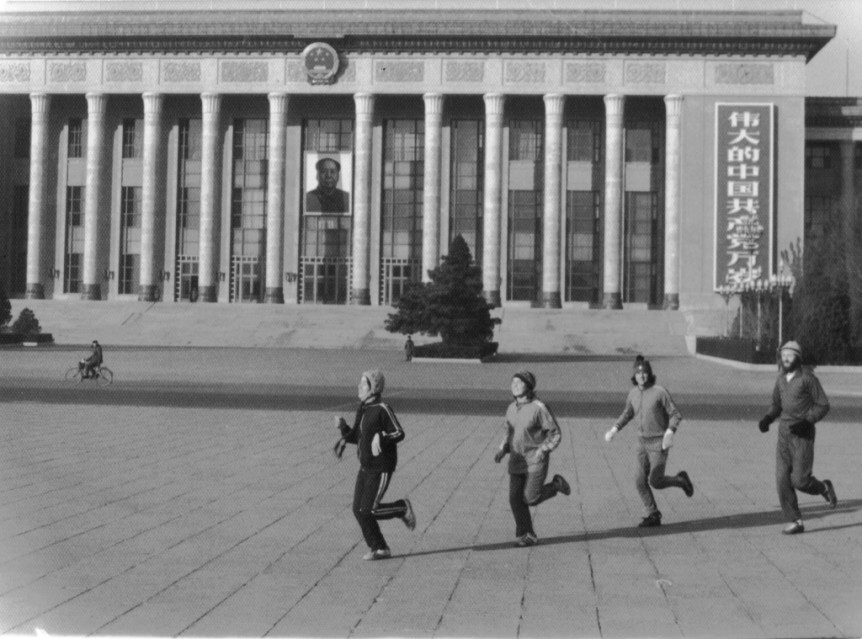
Our so-called translators barely spoke English – we were that early in the opening of China.  They simply were not prepared to interact with another language or another culture.  While all of them looked the same to us – same blue Mao jackets on the men the women, same blue pants, same bicycles for travel – I’m quite convinced that they saw us as a traveling circus.  If we took a walk down a wide boulevard with apartment buildings on it (buildings we would politely call “projects” at home), word would pass quickly along and people literally poured out onto the streets to simply stand and stare at us as we walked past.  At 6’3”, 6’5”, 6’8” and 6’11”, the four tall black men caused many jaws to drop.  My curly, light-colored hair always caught their attention.   The blonde man and woman  were novelties to them, too.  If I went out for a run and stopped to stretch, I would look up in a few minutes and there would literally be over a hundred people who had gathered a safe distance away from me to gawk.  To them I must have been the new space alien delivered to their world.

Tiananmen Square

Tiananmen Square: Linda Gonzalez, Lynda Huey, Alan Silber and Phil Shinnick

There were no colors in clothes.  There were only bicycles for travel, except for the intermittent Mercedes Benz carrying a political big shot down the road that was a sea of two-wheelers.  There were “Friendship Stores,” but only for Westerners.  Chinese couldn’t enter the stores where in each city we could buy low-cost Chinese wooden and cotton items.  It felt wrong to us that we had access to things the locals couldn’t  buy.

We Americans were used to going out in the evenings.  There was NO, that’s right, absolutely NO place that was open for us to go.  Nowhere we could go out to eat; nowhere we could go get a beer.  Nowhere.  We were in our hotel rooms every night, so Boston Red Sox pitcher Bill Lee taught us to juggle the oranges in our rooms.  One by one we got sick, possibly from culture shock, possibly from the terrible air pollution that caused most Westerners until recently to return from China with an upper-respiratory ailments.  The skies were black with the residue from burning coal for heat.  If you blew your nose you saw black.  A few went home early.  But I wanted to see the Great Wall of China.  No one but Chinese people had seen it in over two decades and I wanted to be one of the first Americans.  You can’t get a photo like mine anymore.  These days there are tourists everywhere on the wall and of course a tourist industry has sprung up so that trinkets and souvenirs of the wall can now be bought there.  Not in 1976.  We were the only ones for miles and miles on the wall.

So when I heard this morning that the richest nations on earth were meeting to discuss our messy global economy in Bejing, I remembered that when I was in Bejing in 1976, it was still called Peking in America.  I brought home a small cotton duffel bag with Bejing on the side and everyone asked me what that was.  Now they know.  Now we all know that China has loaned America billions and billions of dollars to prop up our economy, and I have to wonder – how did they get all the money?  I can’t imagine that the Yuan I spent back then, that couldn’t be taken out of the country could become a world currency.  The experts say that the dollar is still king.  But we’ve mishandled our riches and our poor country relations are now bailing us out.  Again, I just shake my head.

Lynda Huey, M.S., founder of CompletePT and Huey’s Athletic Network, is a former athlete and coach whose own injuries led her into the water to find fitness and healing. She was educated at San Jose State University where she starred on the track and field team during its golden years.  In the 1970s and 80s she was a freelance sports journalist.

Print Friendly
Posted in Physical Therapy, Uncategorized | Tagged , , | Leave a comment

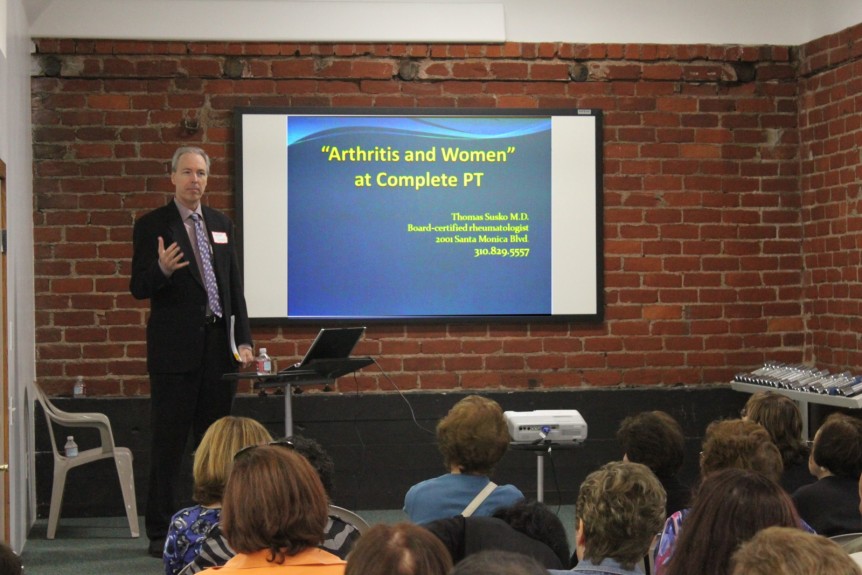
Thomas Susko, M.D. “Women and Arthritis”

As part of CompletePT’s Free Lecture Series to the community, rheumatologist Thomas Susko, M.D., of Santa Monica presented an engaging talk on osteoarthritis and rheumatoid arthritis.  More than fifty people were there, all of them paying rapt attention while learning the latest information that is available in 2011.

_________________

Here are some key points made by Dr. Susko.

Osteoarthritis (OA) is the degeneration of cartilage and the development of bony overgrowth called “spurs” or osteophytes.  OA is synonymous with degenerative joint disease (DJD) in which the cartilage wears down.  There are mechanical factors as well as chemical factors inside the joint that can promote abnormally rapid cartilage degeneration.  It affects nearly 30 million Americans, and with the Baby Boomer generation moving into their sixties, that number is sure to grow rapidly.

Three times as many women develop OA than men.  The symptoms include joint pain and tenderness to the touch, stiffness in the morning or after prolonged sitting, decreased range of motion, and increased warmth.   To minimize the risk of developing OA, maintain your ideal body weight, exercise daily, don’t ignore pain, which will help you avoid joint injury.  Pool therapy allows for patients who have pain when exercising on land to resume activity without aggravating their affected weightbearing joints.

Research showed patients in a randomized study with an exercise program for knee or hip OA had less pain, experienced less disability, and took fewer medications.  Within twelve weeks of entering the study, they also had fewer visits to their MDs.  (Van Baar et al, Journal of Rheumatology, 1998)

Just published in August, 2011 in Arthritis and Rheumatism:  1000 people with knee arthritis had a device attached to measure their activity level.  Inactive was defined as a failure to sustain a 10-minute period of moderate-to-vigorous activity during a week.  It was found that 40.1 % of men and 56.5% of women studied were found to be inactive. More than 20 minutes of moderate intensity walking is recommended daily for adults with arthritis.

Dr. Susko discussed the drugs most likely to be used for OA then explained the risks of the drugs themselves.  Acetaminophen (Tylenol) is contained in many medications but they aren’t labeled as such.  Examples:  Vicodin, Percocet, Ultracet, Midol, and TheraFlu.  Overdoses of acetaminophen are blamed for about 26,000 hospitalizations and more than 400 deaths annually.  Labels are being changed on products and safe dosages are being reduced from 4,000 milligrams   to 3,000 milligrams a day.

Anti-inflammatories of all kinds increase the risk of heart attack.

  • Data released from the University of Florida on July 21, 2011 by Dr. Bavry et al found that the risk of death from cardiovascular causes for 2.3 times higher among patients who chonically used anti-inflammatories than among other patients.
  • In January, 2011, the University of Bern published findings in the British Medical Journal that ibuprofen (Advil, Motrin) was associated with more than three times the risk of stroke and 2.4 times the risk of heart attack.  Naprosyn/Aleve have an increased risk of potentially fatal bleeding stomach ulcers when compared to other non-steroidal anti-inflammatories (NSAIDs).
  • A study at Copenhagen University Hospital published the results of a study in the journal “Circulation” on May 9, 2011 using more than 83,000 patients who had previous heart attack over the age of 30.  The study lasted ten years.  They found a 45% higher risk of having another heart attack or dying within seven days of taking an anti-inflammatory.  After taking the drugs for 30 days, the risk increased to 55-65%.  Even short-term use of NSAIDs are associated with cardiovascular events.

Dr. Susko said do not to take anti-inflammatories if you have had a heart attack. Consult with your treating physician prior to making any changes to your prescribed medication.

What about Glucosamine and Chondroitin?  Dr. Susko presented the results of the GAIT study (Glucosamine/Chondroitin Arthritis Intervention Trial) that was done by the National Institute of Health using our tax dollars.  It was a 6-month study with 1,580 arthritis patients who had mild to moderate arthritis pain.  The Glucosamine and Chondroitin didn’t offer any more pain relief than a placebo pill.  This was followed by another study that lasted two years instead of only six months and there were no statistically significant differences among four treatment groups.  This was published in August, 2010, in the Annals of Rheumatic Diseases.

Steroid injections work quickly to reduce pain if the degree of OA isn’t severe; however, the duration of relief may be from only a few days to a few months.  The potential side effects if given repeatedly include loss of bone strength over time and can even harm the very cartilage that is trying to be saved.

What’s the future of OA treatments?

  • Developing enzymes to counteract the destructive enzymes at work inside joints damaging the cartilage
  • Stimulating cartilage growth factors
  • Transplanting cartilage
  • Pharmacogenomics: the study of different responses to drugs depending on the individual’s genetic makeup

Rheumatoid arthritis (RA) is a chronic type of inflammatory arthritis.  It is an auto-immune disease, meaning that the body’s immune system perceives its own tissue as a foreign enemy and begins to fight it.  RA is a destructive, systemic disease that affects nearly 3 million people in the United States, which is about 1% of the adult population.  The cause for RA isn’t known, but there are most likely genetic and environmental factors at work.  Three times as many women get RA as men, which is the same ratio as OA; however, below the age of 50, the incidence is 4-5 times higher in women than men.  Above 60-70 years of age, the female:male ratio is about 2:1.

The early symptoms of RA are joint point, redness and swelling, and increased warmth, morning stiffness and stiffness in the joints after prolonged immobility.  Fatigue is present as well as a decreased range of motion in the joints.  Symptoms can wax and wane making diagnosis difficult.

To reach a diagnosis of RA, the American Rheumatism Association has the following criteria:

  • Morning stiffness of more than one hour
  • Arthritis of 3 or more joint areas
  • Arthritis of the hand joints
  • Symmetry of the joint involvement
  • Rheumatoid nodules
  • Positive blood test
  • Typical X-ray or MRI changes

Early treatment is very important for RA to minimize joint destruction and long-term disability.  Long-term medical care with regular doctor visits are essential for the disease and for monitoring treatment.  RA cannot be cured, but remission is possible to achieve in many patients.

To summarize his talk, Dr. Susko reminded everyone that arthritis is manageable.  Both OA and RA patients benefit from a well-planned and managed exercise program.  He suggested to those who attended that they consider getting one of CompletePT’s “crack physical therapists” to set up a pool and/or land exercise program for them to reach or maintain ideal body weight, to retain or regain strength and range of motion in the joint(s) affected by arthritis.  For those not in the local vicinity, Dr. Susko recommends getting a referral from their own physician to a PT near them.

In the past eight years, since Dr. Susko has been in private practice in Santa Monica, he has begun examining his patients’ extremities looking for subtle signs of RA even when it is asymptomatic, and by discovering the disease six months to three years before actual symptoms would have begun, can slow down the RA progression with treatment.

Dr. Susko is board certified in rheumatology.  He is a medical staff member of Saint John’s Health Center, Cedars Sinai Medical Center, and Saint Vincent Medical Center.

He can be reached at:

Thomas Susko, M.D.

2001 Santa Monica Blvd.

Suite 783-West

Santa Monica, CA 90404

310-829-5557

Fax: 310-829-5554


Print Friendly
Posted in Physical Therapy, Preventing Surgery | Leave a comment

On The Right Track

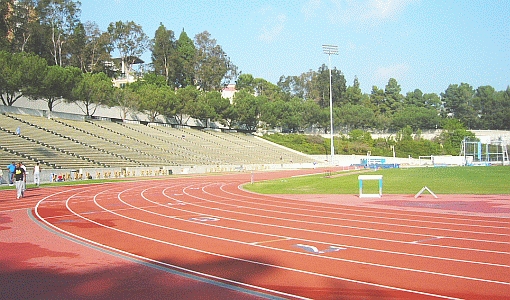
Los Angeles is the sports capital of the world for many athletes both professional and recreational.  Where else can people hike, mountain bike, surf, and play beach volleyball all within a few mile radius?  And nearby is the elite UCLA track at Drake stadium that is known around the world.  On any day of the week an array of entertainment and sports stars gather there for workouts.

UCLA 400m Track

The track is open and available to all.  That’s always a shock to people from the East who cannot just walk right onto a high-level collegiate sports field.  Many athletes from track and field to basketball to football have made it their home track whenever they are in town or whenever they need to train seriously.  Because a group of former or current top athletes can always be found there, it offers the motivation for a tough workout.

And yet many plodders, joggers and walkers come to the track, too.   If you plan to go to a track for a workout, learn your way around first.  Lanes are numbered from the inside out.  Lane 1 is closest to the grassy infield.  Lane 8 (or 9 depending on the track) is on the outside.  Most tracks are no longer the old 440 yards around (a quarter of a mile) but have been converted to the international distance of 400 meters.  To run a mile, you have to go 11 yards more than four laps.  After you’ve familiarized yourself with the general layout of the track – where the long jump runway and various pits are located – it’s time to go over the rules of the road.

  • Never jog in lanes one, two, or three.  These lanes are reserved for athletes who are running timed intervals.  So to warm up by running slowly, you must use the outside lanes or the grassy infield.
  • Occasionally you may hear a coach call out, “Clear lane five… runner coming in lane five!”  Use common sense – clear lane five.  Check to be sure you haven’t drifted from lanes six or seven into five.
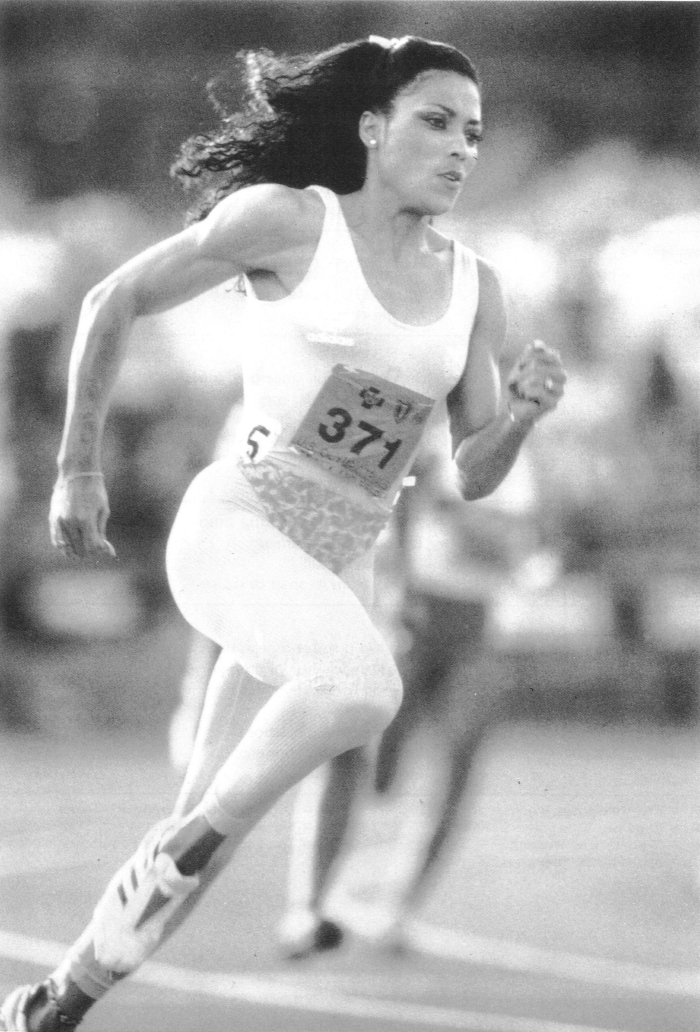
  • Never step into lane one from the infield without looking first for oncoming traffic.  Runners in full flight can instantly appear, so look again, even if you just looked a few seconds earlier.  Of course, you should always look for traffic before stepping from outside the track into lane eight, but generally the fastest runners are in lane one and need constant surveillance.
  • Don’t cross the infield – “No Man’s Land” without first looking at the javelin runway and discus circle.  If either area is in use, go around the track.  Likewise, don’t walk across a long jump or pole vault runway without first looking to the head of the runway for athletes in motion or preparing to start running.
  • When you are ready to run a timed interval, note the speed of other runners in lane one.  Try to begin running with enough distance so that you won’t overtake anyone and no one will overtake you.  Step out of lane one immediately after crossing your finish line.
  • If you are in the middle of an interval and see that you will soon overtake a runner in front of you, yell “Track” clearly and firmly before you reach the potential trouble spot.  Knowledgeable runners will respond to your command by making way for you.  If the runner doesn’t move, you may have to add, “Clear lane one!”   Usually you’ll be able to clear your path with these commands rather than have to slow down or detour around the slower runner.
  • Don’t wear headphones or talk on a phone during a track workout.  Those distractions may make the miles go by when roadrunning, but you need to listen when you’re on the track.  You need to be aware of what’s happening very quickly around you.  Blocking your hearing while keyed-up athletes speed past you is dangerous for everyone.

Once you’ve learned to function smoothly within the normal traffic flow of a busy track, you’ll be surprised to see how much better your workouts can be.  You can focus on your times and distances and even enhance your performance in the upbeat track atmosphere.  So go enjoy the cushioned surface of your local track.  Or if you live near Westwood CA, come by early on a Wednesday morning to join my weekly UCLA track workout with friends.

400m Athletic Track

Lynda Huey, M.S., founder of CompletePT and Huey’s Athletic Network, is a former athlete and coach whose own injuries led her into the water to find fitness and healing. She was educated at San Jose State University where she starred on the track and field team during its golden years.

Print Friendly
Posted in Home Exercise Programs, Physical Therapy | Tagged , , | Leave a comment

Pool Workouts for NBA Centers Wilt Chamberlain & Emeka Okafor

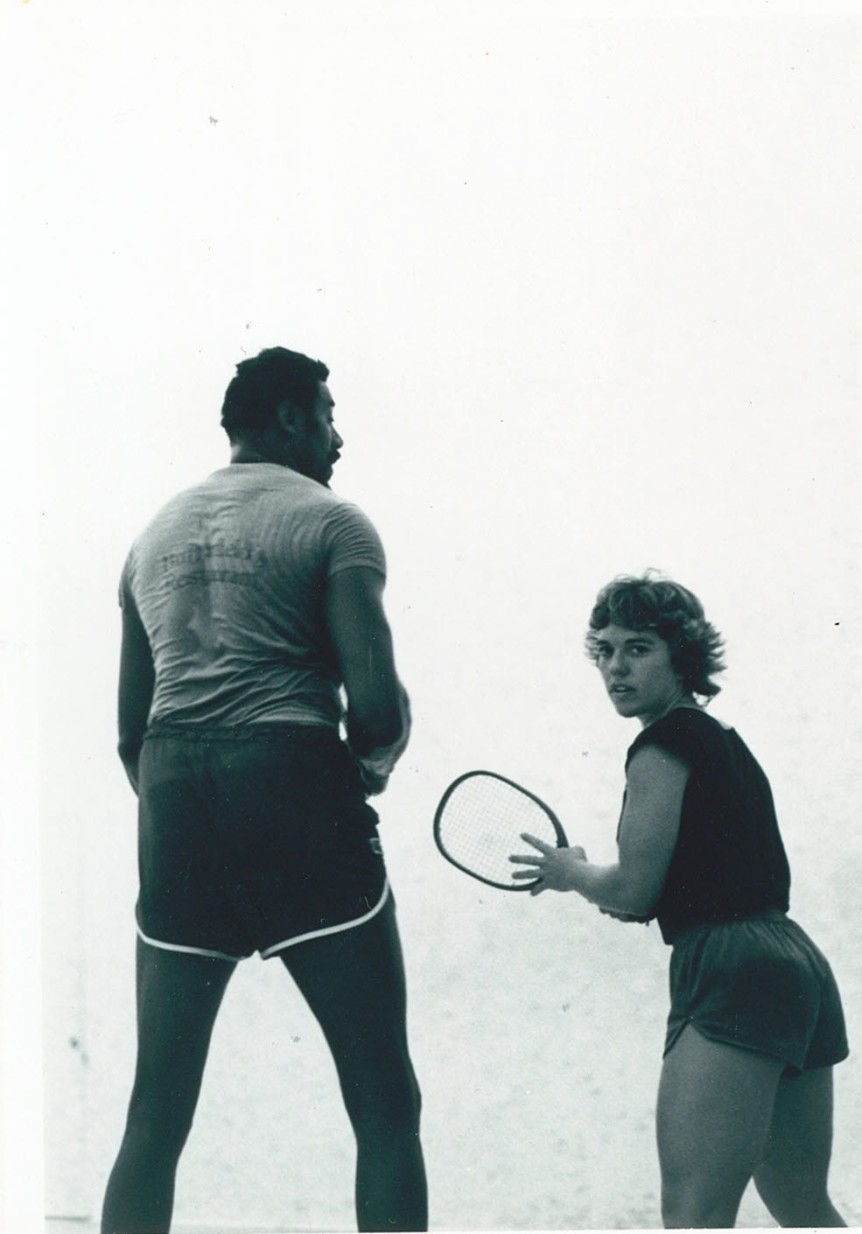
In the 1980s, when I first started taking some of the world’s best athletes into the pool, my long-time companion Wilt Chamberlain had elbow surgery by Frank Jobe, M.D. to repair a triceps tendon he had torn playing racquetball.  Wilt wanted to speed healing and we had learned that pool workouts certainly seemed to do that.  Thus I took Wilt into his home Jacuzzi to let him bend and straighten his elbow in the buoyancy of water.  (See photo.)

Wilt Chamberlain

Dr. Jobe did a high tibial osteotomy on Wilt’s knee some years later.  Right away I began giving Wilt my full pool program three to four times a week.  We did deep-water running, walking and jacks to keep his high level of cardiovascular fitness without any impact to his knee.  Stretches and range of motion exercises for the knee soon had it moving smoothly.  As the knee healed we could do shallow water running and jumping exercises with a flotation belt.  That way he could jump up and the belt and water could catch him on his landing so the repaired knee didn’t have to work nearly as hard as it would have to do if he were jumping on land.  Over the next months, we got him back to playing tennis and paddle tennis.

After Robert Klapper, M.D. performed arthroscopic surgery on Wilt’s left hip in 1994, we returned to the pool for forward, backward, and sideways walking – a lot of it so that he could relearn a walking pattern without a limp.  We did the deep-water interval training, the shallow water running and the plyometric jumping exercises.  What Wiltie loved best, though, was the kicking series.  He loved it!  We started doing each of the six kicks for thirty seconds, then 45 seconds, then a minute.  Over the next month we built up to doing two minutes for each of the six kicks, increasing the speed and force for the last minute of each one.  That was a tough workout all in itself.

Wilt Chamberlain

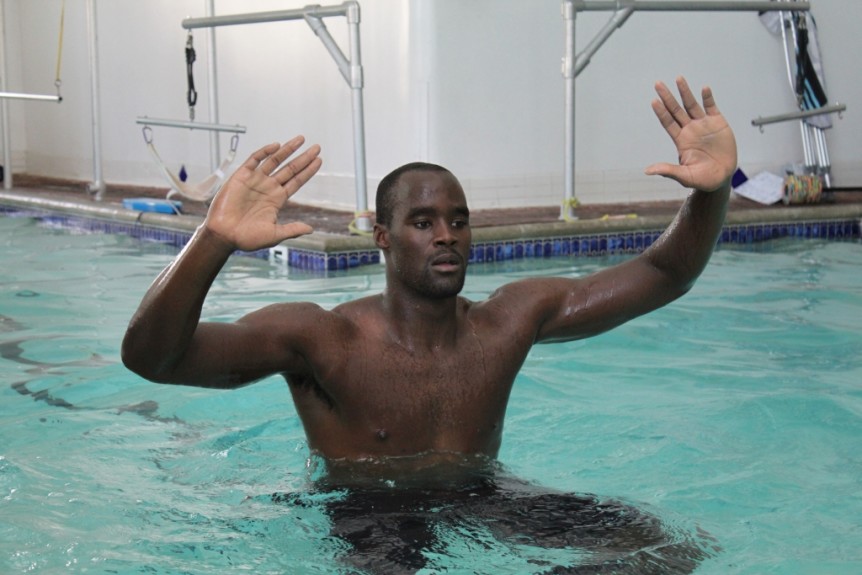
So when Emeka Okafor, center for the New Orleans Hornets, came to Los Angeles in the summer of 2009 to cross train in the off-season, I made sure we spent quality time on the kicking series.  Turned out he loved it, too.  We built up to one minute of each kick, doing the last thirty seconds at high intensity, high speed.  He really worked it!  Here’s what he said:  “That kicking series of yours is……MONEY!!”

Emeka Okafor

Besides the kicking series, I had him do Wiltie Spins, a move created by Wilt during his hip rehabilitation.  “If you use this exercise,” he said, “you have to name it after me.”  And so I did.

Emeka Okafor Emeka Okafor Emeka Okafor

Below is the NBA Centers’ Kicking Series.  To do it, first put on a flotation belt such as a Wet Sweat Belt or a Wave Belt.  With exercises 5 and 6, you can add resistance pieces to your ankles or feet to create more resistance for extra strengthening.

1. Front Flutter Kick

Hold the side of the pool and let your legs float out straight behind you.  Begin small fast kicks with straight legs.  If anything hurts, keep your feel below the surface of the water.  If you feel good doing this, break the surface and kick away.

Front Flutter

2. Slap Kick

Keep holding the side of the pool with your legs out straight behind you.  Bend your one knee as much as you can so your knee lifts out of the water.  Slap the top of that foot against the surface of the water and lift the other foot as far as you can.  If this hurts anything, keep your feet below the surface of the water.

Emeka Okafor

3. Back Flutter Kick

Turn your back to the pool wall and brace yourself with your arms on the edge.  Lift your hips and legs and begin shallow fast kicks with straight legs.

Back Flutter

4. Bicycling

Bend your knees and kick in a bicycling movement.  For an easy version, keep the knees below the surface of the water.  For the advanced version, lift your knees as close to your chest as possible, raise the foot well out of the water, and pull the heel close to the buttocks at the end of each cycle.

Bicycling

5. Straight-Leg Deep Kick

Straighten both knees s you lift one leg to the water’s surface and push the other leg toward the pool bottom.  Moving with strength, switch and reswitch the leg positions.

Straight Leg Deep Kick

6. Scissors

Sit on a step or rest your back against the pool wall as you hold onto the side of the pool.  Extend both legs straight out in front of you and open them sideways.  Cross one leg over the top of the other, open them, then continue crossing and opening your legs, alternating the leg on top.  Use as much force in opening your legs as in closing them.

Emeka Okafor

Lynda Huey, M.S., founder of CompletePT and Huey’s Athletic Network, is a former athlete and coach whose own injuries led her into the water to find fitness and healing. She was educated at San Jose State University where she starred on the track and field team during its golden years.

Print Friendly
Posted in Home Exercise Programs, Physical Therapy, Waterpower Workout | 1 Comment

ICE: A Free, Frozen Miracle

Ice is life’s most under-recognized drug and it needs no prescription.  It’s right there in your freezer waiting for you.  It’s easy to apply to an injury and quick to start working.

When an injury occurs, immediate application of ice constricts the capillaries to help prevent bleeding and swelling in the injured and creating a bruise.  The use of ice decreases the need for anti-pain medication because it is a surface stimulant that overrides the pain in the injured area.  Ice slows nerve conduction velocity.  In other words, ice shuts down many nerve impulses that your brain interprets as pain.

Apply lavish amounts of ice to your injury and the area surrounding it.  Use a large ice bag, a bag of frozen peas, or a gel ice pack – anything you have that will act as ice.  Leave the ice in place ten to twenty minutes, then remove it and place a dry towel around the cold skin until you feel the area thaw.  Wait thirty minutes and then apply the ice again.  Ice off and on as often as possible during the first two days after the injury, then reduce this treatment to twice a day until the injury heals.

In treating neck and back, ice is applied to alleviate pain, spasm or inflammation even though the initial discomfort of the cold may give the impression of stiffening the muscles.  Stay relaxed, stay with it, and the ice treatment will force the muscles in spasm to relax and return to their normal resting length.

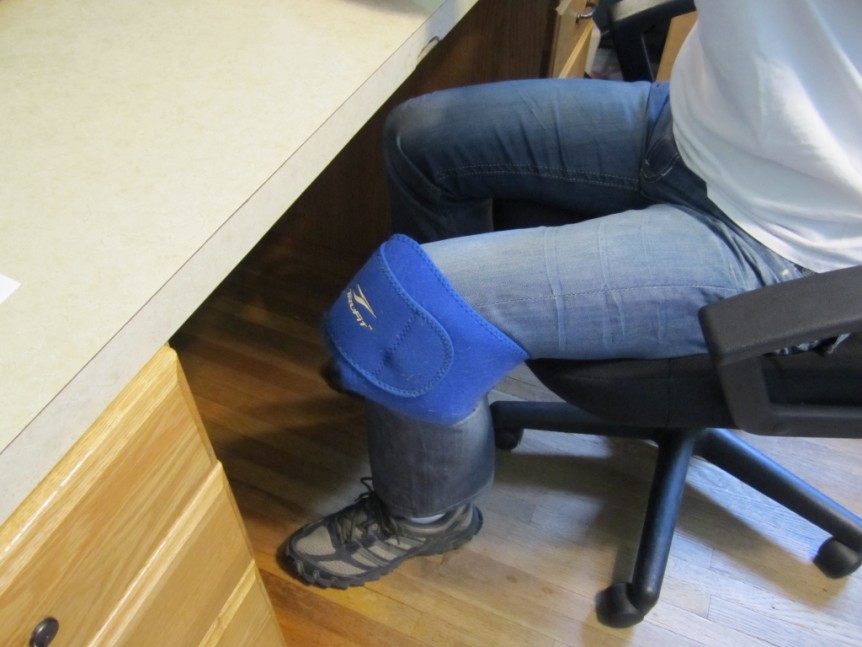
One of the main reasons people “forget” to ice is that they don’t want to sit still to do it.  Now there is no excuse.  You can use ICE/HEAT by TRU-FIT.  This product consists of a freezable gel pack, insulated soft fabric wrap, and an elastic extension strap.  The strap holds the gel pack in the most desirable position over your knee, hip, back, shoulder or other injury site.  You can wrap the ice bag snugly around any injury and continue your daily activities at work or at home.  So while you cook dinner or write your daily blog, you can strap on some ice and speed the healing of your injury – not bad multi-tasking!

Once you are past the first forty-eight hours of your injury the gel pack can go into the microwave and be heated to offer contrast treatments – first cold, then heat, then finish with cold.

Lynda Huey, M.S., founder of CompletePT and Huey’s Athletic Network, is a former athlete and coach whose own injuries led her into the water to find fitness and healing. She was educated at San Jose State University where she starred on the track and field team during its golden years.

Healing Power of Ice

Print Friendly
Posted in Home Exercise Programs, Physical Therapy | Leave a comment